This is an English translation. The original Dutch article is authoritative.
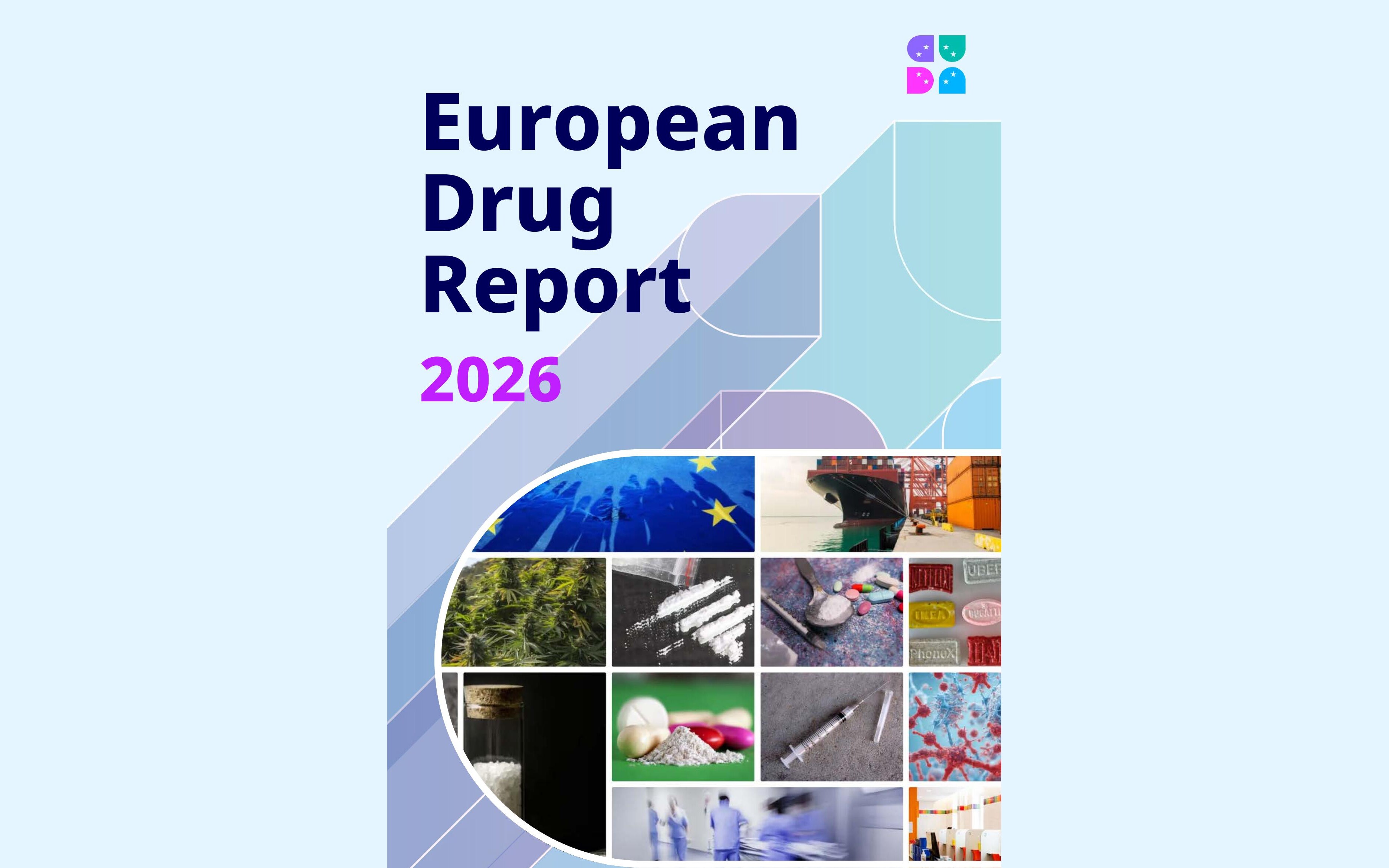
EUDA has published the European Drug Report 2026. In the chapter on cannabis, EUDA outlines the current situation regarding cannabis in Europe. The report addresses usage, product developments, health risks, addiction care, market developments, organised crime, and changes in cannabis policy.
Cannabis remains the most used illicit drug in Europe
According to EUDA, cannabis remains the most used illicit drug in Europe. EUDA estimates that 8.7% of European adults between 15 and 64 years old have used cannabis in the past year; this equates to approximately 25 million people. Among young adults aged 15 to 34, usage stands at 15.3% (approximately 15.4 million people) and among 15- to 24-year-olds at 18.0% (approximately 8.6 million people). Developments vary by country: of the countries that have conducted new surveys since 2023, three countries reported an increase, ten countries a stable picture, and two countries a decrease. EUDA also estimates that approximately 1.6% of all adults and 2.3% of young adults use cannabis daily or almost daily — meaning on 20 days or more in the past month.
Use among students and wastewater data
Cannabis also remains the most used illicit drug among students. According to EUDA, the 2024 ESPAD school survey among 15- and 16-year-old students shows that cannabis is the most used illicit drug in all participating EU member states; on average, 13% of students indicated they had used cannabis at least once. Wastewater data shows a mixed picture: in 2025, 21 of the 63 cities with available data reported an increase in cannabis residues in wastewater compared to the previous year, while a decrease was reported in 28 cities.
An increasingly diverse cannabis market
According to EUDA, the cannabis market is becoming more diverse. Resin and herbal cannabis remain the most available and used cannabis products in Europe, but in addition, more and more other products are available, including products with low THC levels, CBD products, high-potency extracts, edibles, and semi-synthetic cannabinoids. According to EUDA, this product diversity makes it harder to properly assess risks, as products differ in composition, potency, method of use, and potential health risks.
Risks regarding high-potency products and contamination
EUDA points to concerns regarding high-potency products, extracts, and edibles. These products are linked to acute intoxications in emergency departments and reports to poison control centres. EUDA also warns that products sold as cannabis on the unregulated market may be contaminated with potent synthetic cannabinoids. Furthermore, EUDA mentions the emergence of cannabis from North America on European markets; in November 2025, EUDA issued its first warning about this via the European Drug Alert System, as it concerns products with higher potency and potential contamination with harmful pesticides.
Semi-synthetic cannabinoids
Semi-synthetic cannabinoids remain a focus in the report. EUDA mentions the emergence of these substances on the commercial market in parts of Europe; they are often produced from CBD, which can be extracted from low-THC cannabis or hemp, with HHC as a well-known example. In 2026, EUDA was asked to assess CBD as a potential precursor for the production of THC or other psychoactive cannabinoids. According to EUDA, at least three illegal production sites involved in the production of THC or semi-synthetic cannabinoids were dismantled in 2024; two of these were located in the Netherlands and one in Poland.
Daily or almost daily use
EUDA states that people who use cannabis daily or almost daily are most likely to experience problems due to use. The report links this usage pattern to chronic respiratory complaints, dependence, and psychotic symptoms, and also mentions poorer school performance and a greater risk of involvement with the criminal justice system. According to EUDA, early onset, long-term regular use, and high-potency products are particularly associated with a greater chance of problems.
Cannabis in specialised addiction care
According to EUDA, cannabis plays a major role in specialised addiction care. In 2024, cannabis was cited as the primary problem drug in 33% of all admissions for specialised drug treatment in the EU, Norway, and Türkiye. This involved approximately 104,000 clients, of whom about 62,000 people were entering treatment for the first time; among these new clients, cannabis was the most frequently cited primary problem drug, accounting for 41% of all first-time admissions. EUDA also mentions that there is an average of 11 years between the first cannabis use and the moment someone enters treatment.
Hospital data
Cannabis also appears in hospital data. EUDA cites available national data showing that in some member states, cannabis is involved in a large proportion of drug-related emergency presentations in hospitals: in Spain, cannabis was involved in more than 46% of reported drug-related emergency presentations in 2023; in France, this was 28%. Within the Euro-DEN Plus network of sentinel hospitals, cannabis was the second most reported substance in 2024, after cocaine, usually in combination with other substances.
The unregulated cannabis market
The unregulated cannabis market remains large. EUDA estimates the European cannabis market at more than 12 billion euros and states that it generates large profits for organised criminal groups involved in cultivation, smuggling, and distribution; some EU member states report high levels of cannabis-related market violence. In 2024, EU member states reported 252,000 seizures of cannabis resin, totalling 321 tonnes — significantly less than in 2023, when 551 tonnes were reported. For herbal cannabis, EU member states reported 219,000 seizures, totalling 199 tonnes, which remained roughly equal to 2023.
Changing smuggling routes and methods
EUDA describes that smuggling routes and methods are changing. Regarding resin seizures, EUDA sees a sharp decline in 2024: the quantity of cannabis resin seized in the EU fell by 42% compared to 2023, although Spain remained the member state with the largest resin seizures despite that decline. For herbal cannabis, the overall picture remained stable, but EUDA mentions notable increases in Belgium and the Netherlands, involving large batches originating from North America and other non-European regions. Furthermore, EUDA mentions smuggling from Canada, the United States, and to a lesser extent Thailand, and refers to seizures in Spain of drones and speedboats used for cannabis smuggling.
Illegal production within Europe
Besides import and smuggling, illegal cultivation within Europe remains a major source of cannabis. According to EUDA, Spain accounted for 75% of the total number of cannabis plants seized in the EU in 2024. Large-scale production also takes place in other member states, both for domestic markets and international trade; thousands of cultivation sites are dismantled annually, ranging from small and medium-sized locations to industrial production sites.
THC content of resin and herbal cannabis
The average THC content of seized cannabis resin in the EU was 24.6% in 2024 — according to EUDA, approximately twice as high as the average THC content of herbal cannabis, which stood at 12%. Index figures show that the average THC content of resin increased by 66% between 2014 and 2024; for herbal cannabis, the increase over the same period was 19%.
Cannabis policy in Europe
EUDA describes that several EU member states are adjusting or reconsidering their approach to cannabis policy. Models differ per country, but EUDA mentions that these often include elements such as prevention, non-profit sales, monitoring, and evaluation. The report mentions Malta, Luxembourg, Germany, the Czech Republic, and the Netherlands, among others: Malta enabled limited home cultivation, possession of small quantities, and use in the private sphere in 2021; Luxembourg followed in 2023 with limited home cultivation and use in the private sphere; Germany introduced legislation in 2024 for limited home cultivation, possession, and use of small quantities; Malta and Germany also allow non-profit sales to members of regulated cultivation associations; and the Czech Republic adopted legislation in January 2026 allowing individuals to grow up to three cannabis plants for private use.
The Netherlands in the report
The Netherlands is specifically mentioned on several points. EUDA first mentions a sharp increase in the quantity of seized herbal cannabis in the Netherlands in 2024: according to the report, the quantity in the Netherlands rose by 278% compared to 2023, an increase linked by EUDA to large batches originating from North America and other non-European regions. Furthermore, EUDA mentions the Netherlands regarding the production of THC and semi-synthetic cannabinoids: in 2024, according to EUDA, at least three illegal production sites involved in that production were dismantled, two of which were in the Netherlands and one in Poland. Regarding cannabis policy, EUDA mentions the Dutch closed coffeeshop supply chain experiment, which according to EUDA runs in 10 municipalities and starts in 2025; during the experiment, cannabis produced in regulated production sites is sold through coffeeshops. EUDA thus places the Netherlands within a broader European development in which countries seek other forms of cannabis policy and in which monitoring and evaluation play an important role.
Harm reduction in Europe
EUDA devotes a separate chapter in the report to harm reduction. This includes policies, programmes, and interventions to reduce the health risks, social consequences, and societal costs of drug use. According to EUDA, harm reduction is adapting to new and changing drug problems: in addition to injecting use, poly-use, the smoking of stimulants, and vulnerable groups with complex health and social problems are receiving more attention.
EUDA mentions, among others, the following interventions for which the evidence of effect is strongest:
- Opioid agonist treatment (such as methadone and buprenorphine)
- Needle and syringe exchange
- Take-home naloxone for reversing opioid overdoses
- Drug consumption rooms
In addition, drug checking, education, wound care kits, and outreach play a role; much of the other offering is, according to EUDA, still in development or insufficiently evaluated.
Key figures harm reduction 2024–2025
- Needle and syringe programmes were available in all EU member states and Norway in 2024. Only 7 of the 25 countries with data achieved the WHO target for 2025.
- Opioid agonist treatment: 14 of the 22 countries with data achieved the WHO target for 2025. 61% of clients received methadone, 36% buprenorphine.
- Take-home naloxone: available in 19 European countries in 2025. In 17 countries, naloxone is used as a nasal spray, in 7 countries also as an injectable. In Denmark, France, Italy, Sweden, and Norway, naloxone is available over the counter at pharmacies.
- Drug consumption rooms: in 2025, a total of 100 drug consumption rooms were operational in 13 EU member states and Norway.
- Drug checking: in 2025, 11 European countries offered some form of drug checking, at festivals, in consumption rooms, or at fixed locations in the community.
Stimulants and new risks
EUDA notes that the growth in stimulant use is exposing gaps in harm reduction provision. In the last decade, HIV outbreaks linked to the injection of stimulants have been identified in 7 European cities in 6 EU member states, and chemsex — the use of stimulants for sexual purposes, especially within a small subgroup of men who have sex with men — also requires better cooperation between sexual health care and addiction care. The growing intertwining of markets for new psychoactive substances and illicit drugs creates new risks according to EUDA: cannabis mixed with (semi-)synthetic cannabinoids, stimulants mixed with, among others, synthetic cathinones or ketamine, and new synthetic opioids such as nitazenes being sold as heroin or oxycodone. EUDA refers here to a Dutch case from March 2025, where a fatal overdose with isotonitazepyne (a strong nitazene opioid), sold as oxycodone, prompted a rapid risk warning via the Trimbos-instituut; partly for this reason, EUDA has set up a new European Drug Alert System for rapid information exchange and targeted warnings.
Harm reduction regarding cannabis
Despite cannabis being the most used illicit drug in Europe, specific harm reduction advice and interventions for cannabis are often lacking according to EUDA. Higher THC levels in resin and herbal cannabis, growing product diversity (edibles, e-liquids, extracts), and the emergence of semi-synthetic cannabinoids make it harder to develop and implement effective interventions. EUDA concludes that coverage and accessibility of harm reduction services within the EU vary greatly and remain below estimated needs in some countries; rapidly changing drug markets, more complex usage patterns, and risks concentrated in specific groups or settings require further expansion and evaluation of interventions such as drug consumption rooms and drug checking, according to EUDA.
---
Source: EUDA, European Drug Report 2026. Cannabis: www.euda.europa.eu/publications/european-drug-report/2026_en · Harm reduction: www.euda.europa.eu/publications/european-drug-report/2026/harm-reduction_en