
This is an English translation. The original Dutch article is authoritative.
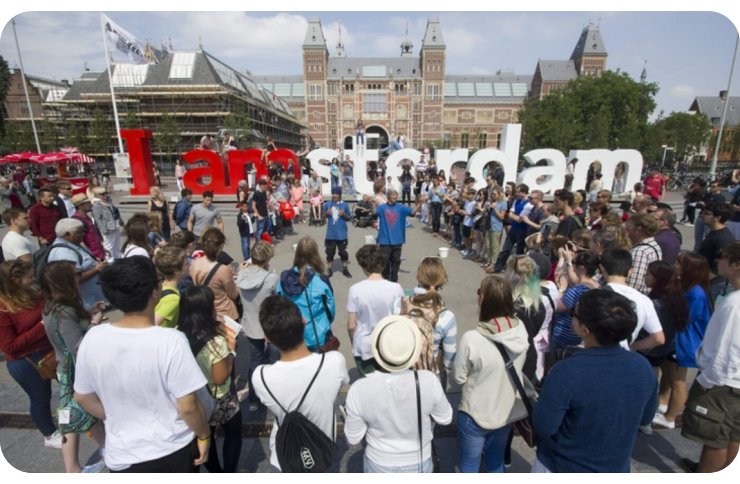
After the corona crisis, it did not remain quiet for long in the Amsterdam city centre. Immediately after the end of the lockdown, deserted streets were transformed into a pleasant hustle and bustle by the first tourists. Now that the borders are opening again, the city centre is filling up at a rapid pace.
Hospitality entrepreneurs are happy and are trying to save what can be saved. They hope not to drown in a sea of sky-high debt. Amsterdam cannot do without tourism. The challenge is to find a way to distribute that tourism across the city in such a way that the city centre is not overburdened and the rest of the city can also benefit from the popularity of the ‘Amsterdam experience’. And coffeeshops could well be a very suitable instrument for this.
Are we heading towards a second failed 1012 project?
In 2009, after intensive political lobbying from City Hall, a majority of the City Council finally agreed after long discussions to a plan to close half of the coffeeshops in the city centre (postcode area 1012). Led by then-Alderman Asscher, Coalition Project 1012 swept through the city centre. That was the solution to urban decay and tourism, they were convinced.
Social engineering proved to be a facade
More than ten years later, this approach proved to be a total failure. Research by the Amsterdam Court of Audit in 2018 made it crystal clear to friend and foe alike that the Red Light District approach had become a fiasco in almost all respects. Nutella and cheese shops, Argentine steak restaurants, and evening supermarkets now define the streetscape thanks to project 1012. Monoculture is the result. Tourists continue to arrive in ever-increasing numbers. Despite the massive closures of coffeeshops, the percentage of tourists attracted to coffeeshops back then has remained the same today, but the number of tourists visiting the city centre has more than doubled. Decimating the number of coffeeshops has not led to a decrease in tourism. The remaining coffeeshops are simply visited much more frequently. But will lessons be learned from this in the coming period?
Old wine in new bottles: coffeeshops once again the scapegoat
Coffeeshops are now being identified as the instigators of all nuisance. More than 30,000 people signed the petition ‘Amsterdam has a choice’, a citizens' initiative that aims to persuade the City Council to set an upper limit on the number of tourists visiting the capital annually. According to the organising committee, this should not exceed 12 million per year, and one of the measures the committee advocates is the introduction of the ‘weed pass’. People not registered in the municipal personal records database would then be banned from visiting coffeeshops.
This is an ill-conceived proposal, as it would immediately cause the streetscape to be dominated by a black market of cannabis suppliers. Already, menu lists are circulating on Instagram with the same range of cannabis strains sold in coffeeshops. If you call a mobile number, the dealer is on every street corner in no time. This was also the sole reason why only coffeeshops were allowed to reopen just one day after the lockdown was announced.
Meanwhile, a new committee has also emerged that simply wants to stifle all coffeeshops. ‘Stop drug tourism in Amsterdam, the hospitable city where not everything is possible,’ this group states in flyers. Who is behind this new initiative remains unknown for now. The initiators remain anonymous. However, a list of sympathisers is mentioned under the appeal, such as the Ouderenpartij Amsterdam (Amsterdam Elderly Party) and a series of hotels. One hotel mentioned in the flyer knows absolutely nothing about it and has since had its name removed. Some others have stated they have nothing against coffeeshops at all.
Do not undermine the revenue model
Perhaps it is time for Amsterdam to start counting its blessings. The corona crisis is bringing a major economic recession in its wake, and the municipality of Amsterdam is deep in the red. In such a crisis situation, it is unwise to undermine one's own revenue model.
If measures must be taken, look at cities like Venice and Rome as shining examples that preceded Amsterdam in curbing crowds of tourists. Look at the effectiveness of measures taken there, such as no foreign number plates in the centre, levying taxes, advance bookings, and so on. You do not deter tourists by pointing to one scapegoat. The fiasco of the Red Light District approach has proven that. A successful approach consists of much more.
Distribution of tourism is an answer. If the coffeeshop is indeed capable of moving people to Amsterdam, then open coffeeshops throughout the entire city, so that the entire city benefits from the income. Outside the centre, large parts of the city are under development. The hospitality industry and shops there would benefit from this. And they are currently taking the hardest hits. Amsterdam does not need fewer coffeeshops, but more.
Mr. Maurice Veldman,
Amsterdam, 27 July 2020