
This is an English translation. The original Dutch article is authoritative.
After the publication of the coalition agreement, one thing is painfully clear: on the cannabis dossier, we are once again exactly where you could see coming from the election manifestos. D66 wants to push through towards regulation and legalisation. The VVD primarily wants to wait and see, making everything dependent on implementation and evaluation. And the CDA wants to return to tightening restrictions and is fundamentally opposed to further normalisation. The coalition agreement is therefore not a breakthrough, but the middle ground where these three parties can find each other without having to make a principled choice.
That compromise is written in black and white in one sentence: “We will continue the experiment, evaluate it, and determine the follow-up steps based on that.” This is not a roadmap; this is an escape. It is the polite phrasing with which a cabinet can say it is “doing something,” while simultaneously keeping the door open to decide nothing. D66 can live with it because the experiment continues. The VVD can live with it because the word “evaluation” is included. And the CDA can live with it because legalisation is not established anywhere. The outcome is administratively predictable: the problem is managed, not solved.
The experiment is not the problem — the lack of commitment is The agreement places cannabis under the heading “Sober policy: drugs, gambling, sex work” and states that a “tightly regulated tolerance policy” applies to soft drugs. That sounds like a neat middle position, but legally and policy-wise, the foundation remains the same: tolerance is an exceptional construction in which norm and practice structurally diverge. A “tight” tolerance policy does not make that tension smaller, but larger. The more tightly the front door is regulated, the more visible it becomes that the back door still does not fit within the system.
Because the core of the problem remains unchanged: the government tolerates sales at the front door but allows the supply at the back door to exist in a criminal-law shadow. This creates a system in which the state facilitates a consumer market but simultaneously accepts that the supply chain remains outside of transparency and control. This is exactly the mechanism through which the illegal market becomes a structural part of implementation. Anyone who then says they want to combat subversion but leaves the back-door issue untouched is, in practice, choosing to let criminals continue managing that back door.
The cabinet writes that the closed coffeeshop supply chain experiment is intended to see whether regulation translates into “increased safety and health.” That is a legitimate objective in itself. The problem lies not in continuing the experiment, but in the political choice to leave the outcome open. The phrasing “we determine the follow-up steps based on that” makes it possible to go in any direction after the evaluation, including further postponement. An open end without direction potentially leads to nothing.
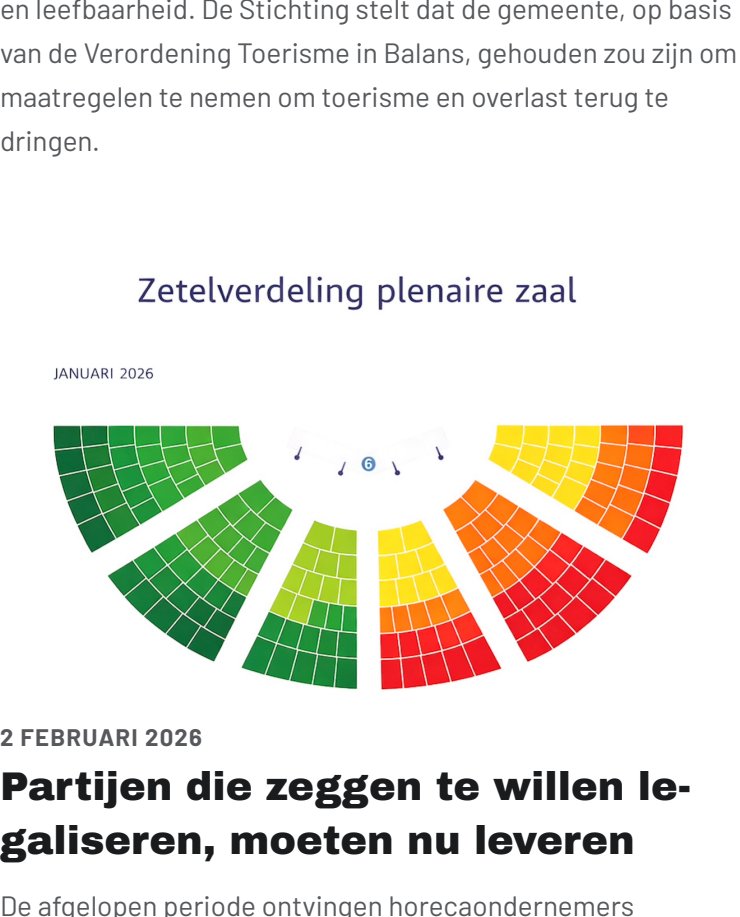
Parliament now has more influence than the cabinet A majority in the House of Representatives requires 76 seats. D66, VVD, and CDA together reach 66 seats in the intended minority construction and thus lack 10 seats to govern independently. This fact is not just a political footnote, but the key to the cannabis dossier. The coalition agreement deliberately contains an open formulation regarding cannabis — “we will continue the experiment, evaluate it, and determine the follow-up steps based on that” — and precisely because the cabinet has no majority, it cannot fill in those follow-up steps autonomously.
At the same time, there is a substantial bloc in the House that does want regulation and legalisation. Parties that explicitly commit to legalisation together hold 68 seats. That is not yet a majority, but it means that only 8 seats are needed to turn the coalition compromise into an actual policy direction. The deciding factor therefore lies with parties that adopt an evaluation-oriented and implementation-oriented stance. As soon as a portion of that middle ground is willing to move, a workable parliamentary majority emerges that can force the cabinet to no longer let “follow-up steps” exist as an open end, but as a concrete step towards structural chain regulation.
Words without money: the budget confirms the shelving What is striking is that the coalition uses words but reserves no resources. The coalition agreement states that the closed coffeeshop supply chain experiment will be continued, evaluated, and that “follow-up steps will be determined based on that.” However, in the budgetary table and annex, a recognisable financial translation of that follow-up step is missing. In the calculations, we see intensifications in national security, DJI, and the rule of law, but no separate item indicating the preparation of structural chain regulation or a trajectory towards legalisation.
This is policy-wise significant. If a cabinet truly wants to take a follow-up step, you usually see this reflected in capacity, implementation, and resources. The absence thereof means that “determining follow-up steps” can in practice become an empty phrase: without a budget, without project-based anchoring, and without political obligation, the cabinet can choose delay again after the evaluation.
A responsibility lies with parties that speak of regulation and legalisation in their programmes, and who do not see the experiment as a final destination but as a stepping stone. The closed coffeeshop supply chain experiment has a finite nature and includes a phase-out period. If the cabinet writes in the coalition agreement that the experiment is continued, evaluated, and that “follow-up steps are determined based on that,” it means the cabinet is not committing to a structural follow-up step but leaving the choice open until the moment of evaluation and the cabinet’s position.
Precisely because the evaluation has no pre-determined “success criteria,” the phrasing in the coalition agreement is meagre. The research measures much and broadly: from public health and safety to crime, nuisance, and the question of whether a closed chain can replace the illegal market. But it is nowhere pre-determined which outcome counts as “successful” and what political consequence must follow. Thus, “evaluating” is not a decision-making mechanism but a source of information. Against this background, the coalition sentence “we will continue the experiment, evaluate it, and determine the follow-up steps based on that” primarily says that the cabinet is not committing itself. Without a guiding choice, it remains possible that even with positive outcomes, no structural step follows, but merely postponement, temporary extension, or eventually a phase-out and relapse into the old tolerance situation.
The Closed Coffeeshop Supply Chain Experiment Act gives the experiment a fixed duration. Article 4, paragraph 1 states that the implementation of the experiment has a duration of four years after the start date. Thereafter, the experiment will be phased out within a maximum of six months. The same article also states that an extension is possible, but only by order in council (AMvB) and for a maximum of one year and six months (Article 4, paragraph 1 Closed Coffeeshop Supply Chain Experiment Act).
Because the cabinet cannot decide what happens to the experiment only at the very end, the law contains a hard deadline for the evaluation. Article 11, paragraph 3 states that the Monitoring and Evaluation Committee must complete the evaluation and send the evaluation report to the ministers no later than eight months before the moment the experiment ends (Article 11, paragraph 3 Closed Coffeeshop Supply Chain Experiment Act). Assuming a start date of 7 April 2025, the experimental phase ends after four years on 7 April 2029, and the evaluation report must therefore be submitted by 7 August 2028 at the latest.
Furthermore, there is a deadline for the cabinet's response. Article 12 states that within four months after receiving the evaluation report, the ministers must send the evaluation report and the cabinet’s position on it to the States General (Article 12 Closed Coffeeshop Supply Chain Experiment Act). Based on the latest possible moment the evaluation report must be in (7 August 2028), this means the cabinet must send the evaluation report and the cabinet’s position to the House of Representatives and the Senate by 7 December 2028 at the latest.
The cabinet’s position is not just a simple “yes/no” about extending. The cabinet’s position concerns the outcomes of the evaluation and the consequences the cabinet wishes to attach to them. It is true, however, that the law strictly limits the possibility to extend within this experiment: extension can only occur via an AMvB and is for a maximum of one year and six months (Article 4, paragraph 1 Closed Coffeeshop Supply Chain Experiment Act).
Finally, the law states that the cabinet cannot immediately establish an AMvB (for example, regarding extension) definitively without involving Parliament beforehand. Article 13 states that a draft AMvB must first be submitted to the States General and that the recommendation for establishment can only take place four weeks thereafter (Article 13 Closed Coffeeshop Supply Chain Experiment Act). An AMvB is not passed by the House of Representatives and the Senate like a law, but through the controlled parliamentary procedure, the House can discuss the draft and exert political influence.
Crucially, an AMvB only pertains to the question of whether the experiment is extended within the legal limits. For the structural continuation of a closed and regulated chain after the experiment ends, a new legislative process is required: a statutory amendment or new legislation for coffeeshops and cannabis. If the maximum extension is utilised, the experiment continues until 7 October 2030. Before that date at the latest, new structural closed coffeeshop supply chain legislation must have entered into force. If that law is not there, a relapse into the old tolerance situation follows, and the closed, regulated chain disappears.
Time to deliver now The publication of the coalition agreement primarily shows where the brakes are. But it also shows where the space is. A minority cabinet cannot lock down the cannabis dossier with one neat sentence, no matter how administrative it sounds. Because this cabinet is a minority, the space lies not in the coalition agreement, but in parliamentary instruments. This is not theory: parties opposed to the experiment are already showing how this works. The ChristenUnie steers not via “follow-up steps,” but via the budget. A budget amendment proposes reducing resources for the experiment, precisely to initiate a phase-out. For parties that do want regulation, the same principle applies, but in the other direction. They can pin down “follow-up steps” well before 2028 by not waiting for the final report, but by preparing legislation parallel to the duration of the experiment. Motions can be linked to interim reports, for example, by establishing that the cabinet publishes scenarios for the period after the experiment in a timely manner and that, in the event of positive trends in safety and public health, the preparation of structural legislation is actually started. In this regard, money and capacity are not details but prerequisites. By freeing up resources now for the development of scenarios, legal design, and implementation tests, it can be prevented that structural legislation has to be designed, calculated, and introduced under time pressure later. This turns “determining follow-up steps” into a prepared trajectory, instead of a rush job at the end.
Because if we do not do that, we know exactly where we will stand again in four years: once more in the middle, once more with the same back-door issue, and once more with the same political text that was primarily intended to let no one lose.
Editorial BCD, 2 February 2026