This is an English translation. The original Dutch article is authoritative.
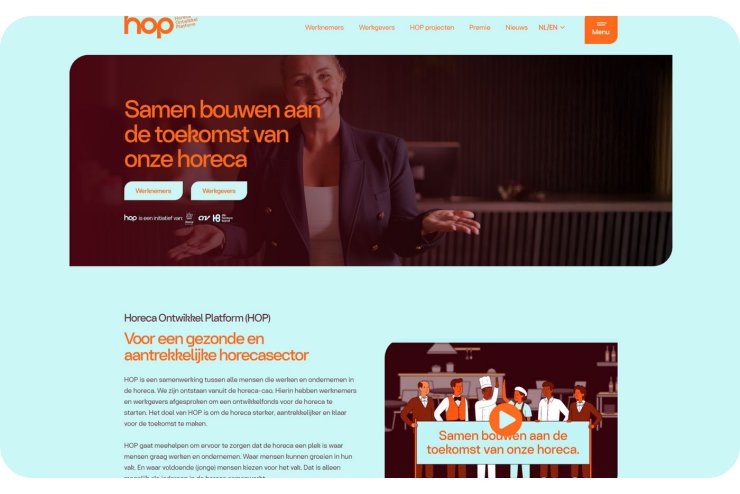
Recently, hospitality entrepreneurs have been receiving invoices from the Horeca Ontwikkel Platform (HOP). These invoices came unexpectedly for many entrepreneurs, leading to immediate questions regarding their origin, the obligation to pay, and the manner in which this was introduced sector-wide. For some entrepreneurs, this even led to doubts about whether the sender was legitimate. It has since become clear that HOP stems from agreements between social partners in the hospitality sector (employer organisations and trade unions), is established in the hospitality collective labour agreement (cao), and applies sector-wide because these agreements have been declared generally binding by the Minister.
Coffeeshops are hospitality operations. They operate on the basis of a catering permit, are classified in the Trade Register with hospitality SBI codes, and fall under the hospitality cao. Employees are likewise registered with the hospitality pension fund. Consequently, coffeeshops fall under the scope of the HOP.
The core principle is that HOP is designed as a joint instrument to make the hospitality industry more future-proof as a branch. Through this, the sector aims to structurally invest in craftsmanship, recruitment, retention, and staff development. Precisely because many hospitality businesses struggle with the same challenges—staff shortages, high workloads, turnover, and the question of how to keep employees sustainably employable—the idea arose to stop organising everything individually and instead invest collectively in projects that strengthen the entire sector.
From cao agreement to sector fund
HOP originated from agreements between social partners in the hospitality industry: employer organisations and trade unions. In the Netherlands, this is a well-known method for setting up sectoral facilities. Within the context of a cao, agreements are made not only regarding wages and working hours, but also on themes such as training, sustainable employability, and recruitment into the branch. Similar O&O funds (training and development funds) exist in other sectors: industries then collectively organise a pool of money to enable broad labour market and development projects.
Within the hospitality cao, the starting point that structural investments must be made in the development and training of employees had existed for some time. In practice, it appeared that this effort was not always utilised structurally. HOP has replaced this to better organise it sector-wide: not as a separate responsibility for each entrepreneur, but via a collective fund that gathers resources and deploys them for projects within the hospitality industry.
This creates space to set up larger trajectories, such as sector campaigns, innovation programmes, training structures, or projects surrounding sustainable employability. In fact, HOP is a way to structurally and collectively organise development and training within the sector.
HOP positions itself as an investment in the future of the hospitality sector. The contribution is used for projects intended to strengthen the sector, for example, by ensuring better working conditions, increasing staff recruitment, improving the alignment of education with practice, and creating a stronger image for the branch. This is therefore not just about courses, but also about improving the functioning of the sector as a labour market.
It is important to mention this positive starting point, precisely because the contribution initially comes across to many entrepreneurs as "yet another extra cost item". However, the intention is that this money flows back into projects that benefit the hospitality sector in practice. For coffeeshop entrepreneurs, there is an additional factor here: coffeeshops are hospitality operations with staff within the hospitality cao and pension funds. For this reason, we believe it is important that coffeeshops not only contribute but also actually have access to the opportunities that exist within the fund, such as subsidy applications and project participation. If it is set up sector-wide, it must also be usable sector-wide.
As an interest group, we are therefore actively working on this. We are mapping out which opportunities are available so that coffeeshop entrepreneurs can actually make use of projects and schemes within the fund, and which routes exist to join initiatives that suit our branch.
Contribution, administration and practical consequences: what you need to know as an employer
The contribution for HOP totals 0.2% of the wage subject to social insurance contributions. This contribution is divided into a 0.1% employer share and a 0.1% employee share (deduction from wages). From 1 April 2025 (or 24 March 2025 in the case of four-weekly payment), this deduction must be correctly processed in the payroll administration as a separate item. This must be visible on the payslip, so that employees can see what is being deducted and what it is intended for. In November 2025, a welcome letter will follow with a request to supplement data. After that, the entrepreneur will receive the first contribution invoice. In 2025, this will involve two invoices shortly after each other; from 2026 onwards, this will occur quarterly.
For entrepreneurs who have questions about their invoice or doubts about the data, it is wise to check this via the portal and contact them if necessary. Formally, an objection is possible, particularly if there is a case of incorrect data or an administrative error. At the same time, the scheme stems from cao agreements and is linked to the sectoral scope. Consequently, the room to structurally remain outside of the contribution is limited when a business falls under the hospitality sector.
Practical: portal and contact
You can log in via the employer portal: https://portaal.horecaontwikkelplatform.nl. The welcome letter contains a QR code with which you can log in and supplement your details. In the portal, you can, among other things, change the billing email address, phone number, and IBAN for direct debit.
Questions about billing, payment, or your invoice? Please contact HOP via 088 003 96 00 (Mon–Fri 08:30–17:00) or facturatie@horecaontwikkelplatform.nl. Always state your employer number.
For all other information and the extensive FAQ, we refer to: www.horecaontwikkelplatform.nl. Members can, of course, also contact us if there are any questions.