
This is an English translation. The original Dutch article is authoritative.
The corona crisis shows what happens to Amsterdam if tourists are banned from the city centre, as the city council is considering via the resuscitation of the residents-only criterion for coffeeshop customers. Mr. Maurice Veldman argues for the recognition of the social importance of the cannabis sector.
Images of long queues of people waiting in front of coffeeshops went all over the world. Visitors to coffeeshops had only half an hour to stock up on a supply of cannabis before the drastic measures announced on 15 March 2020 would become a reality. Huddled close together in line, no problem.
New distance criterion
Roughly a week later, the queues are nowhere to be found. The coffeeshops remained open as takeaway counters after all, and a new distance criterion became a reality. The old distance criterion was intended to close coffeeshops; the new distance criterion is precisely a condition for keeping coffeeshops open. At least one and a half metres distance between visitors must protect people from infection with the coronavirus.
Deserted streets
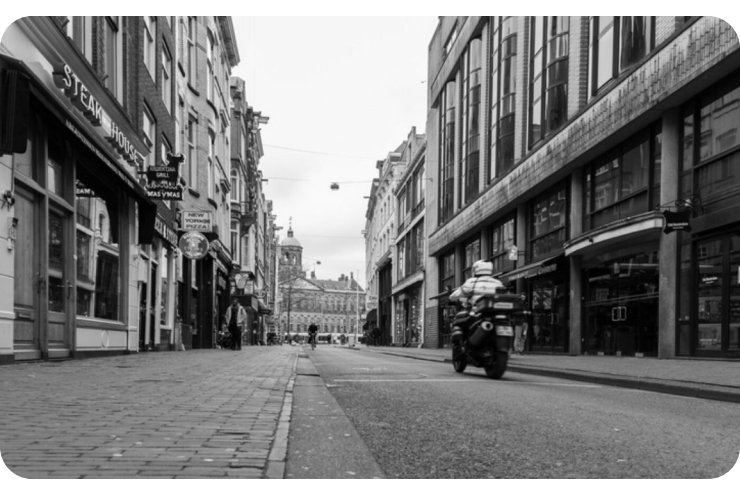
A walk along the Damrak towards the Red Light District. All food and beverage outlets are closed for at least the coming weeks. The coronavirus has had a major impact on street life, which has been decimated to a few pedestrians and cyclists. People walk around aimlessly looking for the entertainment that was the trademark of the city centre, but which is now nowhere to be found.
Coffeeshops as service counters
A look at the awnings of the coffeeshops fits seamlessly with the vacant street scene. There is almost no one to be seen, more than a week after the announcement of the great calamity that will grip the entire country for the foreseeable future. The Amsterdam city centre is not expected to revive in the coming weeks. The measures have been tightened and will likely become even stricter. Without a good reason, you simply have to stay inside.
Tourists head home
Virtually all tourists have hurried home; reportedly, about 90 percent of hotel rooms are empty. Restaurants are closed, despite the promise from the Minister of Health that restaurants and coffeeshops may remain open for takeaway functions. What about the coffeeshops? Are there queues at the door now that no one is allowed inside?
If only that were true, many an operator would musingly remark. The feverish departure of virtually all tourists from the Amsterdam city centre has not only led to acute hotel vacancies, but also to great quietness at the coffeeshop points of sale in the city centre. Due to the suspension of the hospitality function as well, turnovers in the city centre have dropped significantly.
Coffeeshops also take measures
Coffeeshops may be open as takeaway counters, but operators, just like the rest of the hospitality industry, find themselves forced to apply for reduced working hours for their staff. The costs are exorbitant. The fact that many coffeeshops have a bit more financial buffer than many other hospitality businesses does not change this. The government's gesture of tax deferral is a welcome measure for the next three months, but it does not alter the fact that the total damage will be enormous. No one knows where this will lead.
Effects of corona crisis as a benchmark for future measures in Amsterdam
Before the outbreak of the pandemic, the mayor announced that she wanted to explore measures this coming summer to alleviate the pressure of the tourist flow on the city centre. The municipality has been advised to cut into this tourist flow, proposing all sorts of radical measures such as taking the residents-only criterion out of mothballs.
The rapid metamorphosis of the Amsterdam city centre in times of corona from a pool of sin to a deserted graveyard gives an idea of what the city would look like if the plans of the Amsterdam city government were to come true. This is the Amsterdam of the future if tourists are partially barred from the city centre through the introduction of the residents-only criterion. Resuscitation of the residents-only criterion is considered the ultimate measure to drive cannabis enthusiasts from outside the Netherlands away from Amsterdam. It reportedly concerns 22% of all tourists who want to visit coffeeshops as a primary reason for heading to the capital. If more than one-fifth—or a part thereof—stays away, then with the current hotel occupancy, the damage can be fairly well calculated. The corona crisis can thus be used to visualise the consequences of proposed measures.
Social function of coffeeshops underlined
The government's decision to allow coffeeshops to operate as takeaway functions was not prompted by an effective lobby from industry associations or by government sympathy for coffeeshop owners. This rapid decision is the result of immediately emerging public order problems because street dealers immediately shifted to selling on the street. This would in turn lead to significant public order issues, which was exactly what the government could not afford right now. Such problems were immediately raised by mayors in the south of the country.
The exceptional position of coffeeshops relative to the general rule to lock down the hospitality industry is convincing proof of the indispensable social function that coffeeshops fulfil. When the crisis is over, the Bond van Cannabis Detaillisten can use this achievement to convince the government to finally take measures with appropriate speed to remove cannabis as a prohibited substance from the Opium Act. Protection of public order was once one of the motivations for introducing the tolerance policy. This same argument could now be the meaningful impulse to push through and modernise the Opium Act. To begin with, by no longer regarding cannabis as an illegal drug.
Mr. Maurice Veldman, Amsterdam 26 March 2020