This is an English translation. The original Dutch article is authoritative.
EINDHOVEN – The Verbond voor Opheffing van het Cannabisverbod (VOC) foundation sent posters for the ‘What is Nederhasj?’ campaign to all coffeeshops participating in the wietexperiment this week. The website of the same name had already been online for some time.
From 1 September 2025, the 75 coffeeshops participating in the closed coffeeshop supply chain experiment will only be permitted to sell regulated cannabis products, produced by the designated growers in the experiment. Foreign hashish from traditional production countries such as Morocco, Afghanistan, and Nepal will therefore disappear from the menu. In its place comes Nederhasj, in various varieties.
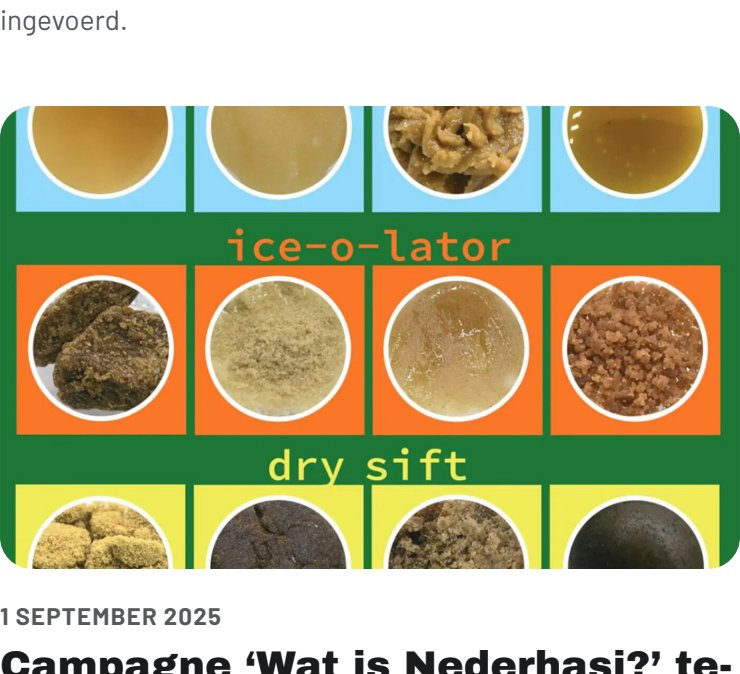
Many Dutch cannabis consumers have little knowledge of or experience with modern concentrates such as rosin, static sift, or ice-o-lator. To inform visitors of the coffeeshops participating in the experiment about the diverse types of Nederhasj, the VOC developed the ‘What is Nederhasj?’ campaign.

The campaign consists of a poster with a QR code for the coffeeshops and the website www.watisnederhasj.nl. The site contains information and photos regarding the different types of Nederhasj and how to use them. There is a page with frequently asked questions and a glossary with explanations of terms such as dabbing, full melt, and WPFF.
The aim of the campaign is to increase the consumer's level of knowledge and reduce the trepidation regarding modern concentrates. It is prohibited for both coffeeshops and growers to engage in any form of advertising, and the national government provides no information about modern cannabis concentrates. Therefore, the VOC, as an independent foundation without commercial interests, has taken on this task.
VOC chairman Derrick Bergman: ‘We are primarily targeting visitors to the closed coffeeshop supply chain experiment coffeeshops, but with the website, we also inform other cannabis enthusiasts, coffeeshop employees, journalists, administrators, politicians, etcetera. Our message is not that Nederhasj is worse or better than traditional, imported hashish. It is primarily a different product, which you use differently.’
As far as the VOC is concerned, both regulated Dutch and foreign hashish should be available in coffeeshops. Bergman: ‘Just as I buy red wine from Italy, Chile, or South Africa, I would also like to be able to legally buy fair trade hashish from Morocco, India, or Nepal.’
Editorial team 1 September 2025